
 ELT Buzz
 Over the last few weeks I’ve been following a lot of forums, FB groups and discussions pertaining to teachers transitioning to teaching online. It’s enlightening and it is refreshing to see so many educators sharpening their ed-tech skills and tackling a difficult situation.
However, one thing is failing to be tackled and asked in all the rush – “Will our students be truly learning?” I know right now, everyone just wants an online solution – the learning can come later. However, I don’t think that’s the right approach – we should think carefully about what we are doing and not just get something going, for the sake of getting something going.
What do I mean by – “Are our students learning?” Well, unlike the face to face classroom, the online class lacks physical presence. You might be having students doing activities in breakout rooms or showing your slides but – “What are your students REALLY doing?” They might not use video (more on that later). They might be playing video games and hitting the “wave” when you ask. Who knows?
I think this moment of ed tech enthusiasm is an opportunity. An opportunity for us to truly embrace the fact that teaching is a student – teacher compact, a contract based fully and truly on trust. We need to embrace that and promote that feature of the teacher – student relationship.
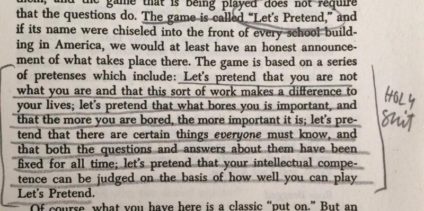
In the face to face classroom, I’ve always felt there was too much control. I pretend to teach and students (by god!) better pretend to learn. Not looking at your book? Detention. Call your parents. It lacks trust and true “caring” in the sense that Nel Noddings uses that term central to a teacher’s core beliefs. Online teaching really supposes we trust students to learn – we simply can’t “enforce” and “bully” students into learning when they really don’t want to or don’t understand they should. Or we might end up in a situation like that outlined in Teaching As A Subversive Activity.
I’m also rather frightened of how “command and control” will come into and enter the dynamic of the online classroom whether by teacher control or by designed ed tech. Already we have teachers being asked to spend precious online class time to take attendance. App developers are busy with next tools to ensure we measure all the time students are sitting at their keyboards and “keystroking”. Invasive tools are being called for so that teachers know students are looking at the screen. This is not a road education should go down. It’s a good opportunity to make a clean break – to renew the trust that is at the core of the student – teacher compact.
However, there are a few specific things you can do to build and create trust and also help to keep student attention in the online classroom or course. Not signals and busy work stuff. But ways to get everyone on the same page and promote accountability.
To end, we need to think hard about our own beliefs about teaching and learning given our transitioning to online teaching. It’s a different ball of wax. We need to truly embrace trust and teacher expectancy – our trust and belief that students can learn well and succeed as learners. Here is a great video about this facet of the student – teacher relationship by the impeccably poignant Benjamin Zander. A must watch.

I have been teacher training, helping teachers in one capacity or the other since 1993 - the first time I went to a…

I think that when it comes to learning a language and typical schools, classes, coursebooks, exercises, instruction,…

I have had the honor to visit perhaps 1,000s of classrooms over the span of my career. A classroom is a "space" that…


Never miss a thing! Subscribe. We'll never spam you!
All the "buzz", news, products, people, resources related to English language teaching




Leave a Reply